
Selling your home · Palm Beach County
How David Abernathy markets a luxury home
The question is not simply where a home will be advertised. It is how the right buyer will find it.
David Abernathy builds Palm Beach County luxury-home marketing around three paths of buyer discovery: the internet, other real estate professionals and the local market. The strategy begins before launch, with a conversation about the seller’s goals and market research that determines how the property should be positioned.

Getting started
How does the process start? With an interview.
David asks what the sale needs to accomplish for you and your family: timing, what matters beyond price, constraints, communication expectations and what you want from the agent you hire.
The marketing plan follows from those answers. The conversation also gives both sides an opportunity to decide whether they are a good fit before making a commitment.
The approach
How will buyers actually discover this property?
Many real-estate marketing plans describe the media that will be produced or the websites on which a listing will appear. Those things matter. David starts one step earlier.
- 01 / Buyer discovery
Internet
Make the property easier to discover through MLS, real estate portals, email and AI-assisted search.
- 02 / Buyer discovery
Real estate professionals
Identify and reach agents who work with buyers likely to consider the property.
- 03 / Buyer discovery
Local market
Deliberately reach people around the property who may know the eventual buyer.
The objective is not simply more exposure. It is more relevant exposure.
01 / Internet
Marketing a luxury home on the internet
Digital pricing
Agents and buyers often search the MLS by typing in price ranges, and those ranges frequently end or begin at round numbers.
A home listed at $995,000 appears only in searches whose upper limit reaches $995,000 or more. For example, it can be found in a search up to $1,000,000. The downside is that it can miss a buyer searching from $1,000,000 to $1,500,000. A home listed at $1,000,000 can appear in both a search ending at $1,000,000 and one beginning there.
Market analysis still determines the defensible price range. Digital pricing helps determine where within that range to land. The same principle can matter at luxury thresholds such as $2 million, $3 million, $5 million and $10 million.
Complete listing information
A property cannot reliably match a search criterion that is missing from its listing data. Saved searches may depend on fields such as subdivision, waterfront characteristics, golf, boating and community amenities. Listing remarks and amenity descriptions can also provide information that rigid filters miss.
David creates comprehensive, accurate listing information and compelling remarks that go beyond the basics—describing the property’s features, setting and lifestyle in detail so buyers, agents and AI-assisted search tools have more information to identify a strong match.
AI-assisted property search
Major real-estate portals increasingly allow buyers to describe what they want in ordinary language rather than relying only on checkboxes and filters. A buyer might search for a home suited to boating, privacy, entertaining, golf, multigenerational living or a particular lifestyle. Search technology can only work with the property information available to it.
David’s objective is not keyword stuffing. It is to describe the property completely and accurately enough that both people and search technology can understand what makes it relevant.
Photography and presentation
Search discovery gets a buyer to the listing. Presentation determines whether the buyer keeps looking. Photography, sequencing, remarks and supporting marketing should tell a coherent story about the property, beginning with the features most likely to matter to its target buyer.
02 / Real estate professionals
Reaching buyers through other agents
A buyer’s agent can be one of the most important distribution channels in luxury real estate. David uses transaction data to identify agents who have represented buyers of similar properties by price range, property type and location, then reaches them directly when appropriate.
His professional network includes relationships developed through MIAMI REALTORS®, BeachesMLS, Waterfront Properties & Club Communities and Waterfront’s national and international luxury network, including LuxuryRealEstate.com.
The objective is specific: put the property in front of professionals who have demonstrated that they work with buyers for this type of home.
03 / Local market
Reaching the local market
The eventual buyer is not always reached through an internet search. Neighbors, friends, relatives, open-house visitors and other people connected to the community can know someone who wants to live there. David therefore treats the local market as a deliberate third distribution channel rather than an afterthought.
Geographic focus
Where to focus a property’s marketing
David uses property and market data to guide selective marketing for each listing—within Palm Beach County, in Martin County and in other relevant counties across Florida and beyond.
Locally, that research helps identify areas and residential properties relevant to the home being marketed. For other counties, IRS migration patterns add context about where incoming tax filers previously lived and the income associated with their returns. County parcel searches and ZIP-code income data provide additional geographic context. Each community report on this site also shows where current owners receive their tax bills.
These sources guide geographic marketing decisions; they do not establish an individual’s purchasing budget or intention to buy.
Explore Palm Beach County migration, Martin County migration, county parcel searches and ZIP-code income trends.
Market intelligence and AI
A significant property deserves more than a CMA.
Before launch, David studies the property’s competitive segment: recent sales, active competition, contracts, price reductions, days on market, negotiating patterns and expired or canceled listings. AI can expand the amount of information that can be reviewed and compared, but David’s real-estate experience determines which comparisons are meaningful and what conclusions the evidence supports.
- 01 / Strategy
Define the real competitive market
The most useful comparable is not necessarily the closest house. Start with the properties a serious buyer would realistically consider instead of yours.
- 02 / Strategy
Study what sold
Examine recent closed sales, pricing, price per square foot, market time, property characteristics, and the differences that may have influenced buyer decisions.
- 03 / Strategy
Study what did not sell
Canceled and expired listings are part of the market evidence. Understanding why similar properties failed can be as important as studying successful sales.
- 04 / Strategy
Understand today’s competition
A seller competes with what a buyer can purchase now—not simply with what sold six months ago.
- 05 / Strategy
Position the property
Price is part of positioning, but not all of it. Condition, location, lot, views, access, design, amenities, timing, and competing inventory can all influence how a property should enter the market.
- 06 / Strategy
Build the marketing strategy
Once the competitive position is understood, the marketing should communicate the characteristics that distinguish the property and matter most to the likely buyer.
After launch, he continues watching the segment. If a competing home reduces its price, a new property enters the market or another goes under contract, the seller should understand whether that changes the property’s position.
Experience behind the approach
Eighteen years of listing presentations and marketing leadership
David spent 18 years as Waterfront Properties & Club Communities’ Business Manager, from 2008 through August 2026. During that period he:
- Conducted more than 1,000 listing presentations for Waterfront’s agents
- Led the company’s marketing team
- Worked alongside agents on market insights most days
- Educated agents on market trends
- Helped lead marketing, technology and AI initiatives
His current approach reflects years of seeing how listings were positioned, marketed and evaluated across the brokerage—not only his own transactions. Meet David
The record behind the strategy
More $5M+ buyers and sellers chose Waterfront than any other office.
From October 2025 through September 2026, Waterfront Properties & Club Communities ranked first among all BeachesMLS offices in $5M+ residential sales across Jupiter, Tequesta, Palm Beach Gardens, North Palm Beach, Juno Beach, Jupiter Inlet Colony, Singer Island and Hobe Sound, in dollar volume and in units, on both the listing and the buyer side.
For a seller, that means the firm’s marketing reaches the buyers at this level, and its agents represent more of those buyers than any other office. Those sales closed during David’s 18 years as Waterfront’s Business Manager, when he oversaw the marketing team and the market analysis behind more than 1,000 listing presentations. The agents held the client relationships and received the transaction credit, and Rob Thomson’s relationships and social media presence remain major sources of the firm’s business. The marketing and analysis behind those results is what David brings to your sale.
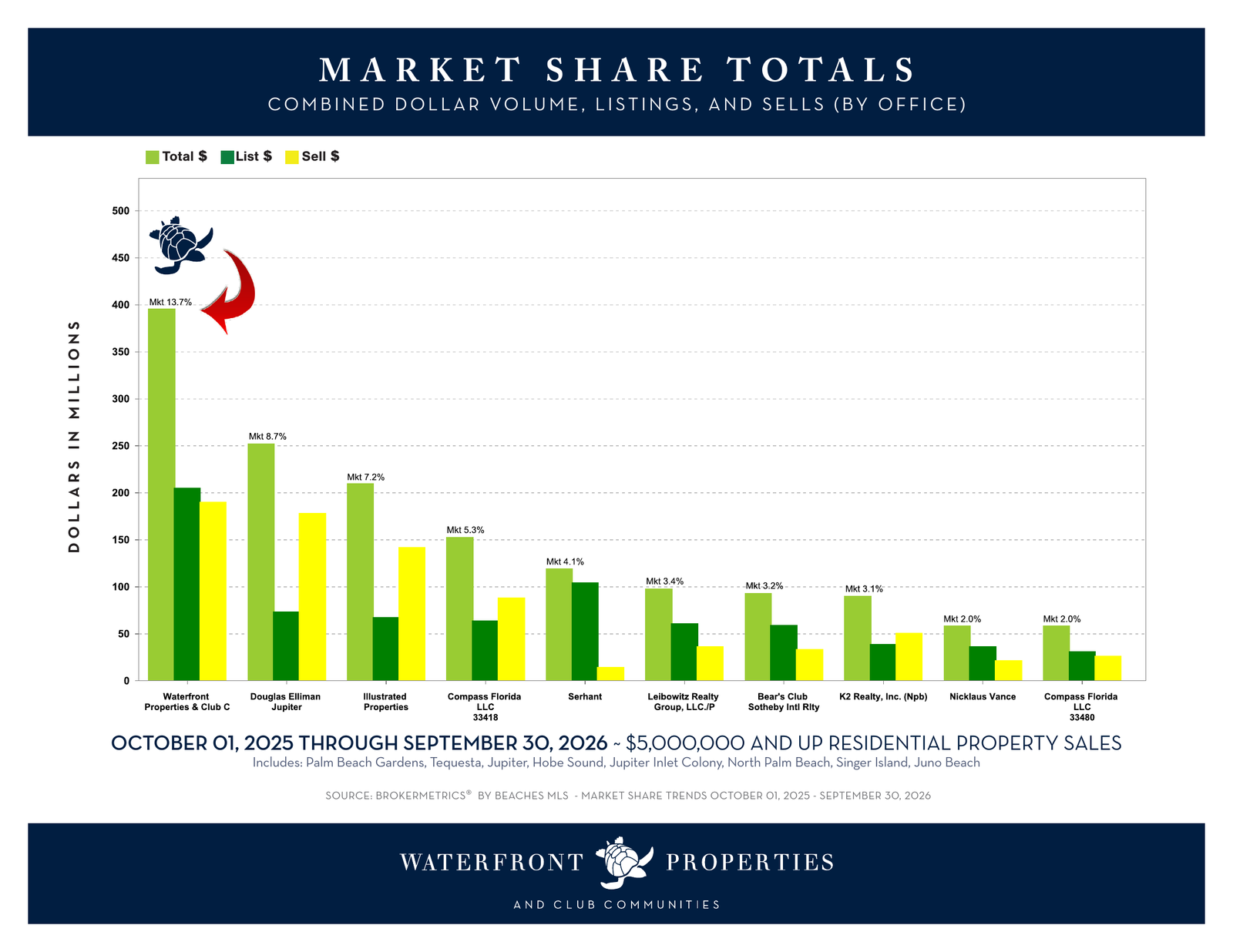
| Measure | $5M+ | $10M+ |
|---|---|---|
| Combined dollar volume | 13.7% · first | 17.4% · first |
| Listing-side dollar volume | 14.2% · first | 14.4% · first |
| Buyer-side dollar volume | 13.1% · first | Not in report |
| Combined units | 12.6% · 39 units · first | 18.4% · 14 units · first |
| Listing-side units | 13.8% · 22 units · first | 17.5% · 7 units · first |
| Buyer-side units | 10.9% · 17 units · first | 18.4% · 7 units · first |
Report scope and terminology
Period: October 2025 through September 2026. Property types: single-family residences, condominiums, townhouses and villas. Comparison: By office; Beaches MLS, Total Sold List + Sell. Included cities: Jupiter, Tequesta, Palm Beach Gardens, North Palm Beach, Juno Beach, Jupiter Inlet Colony, Singer Island and Hobe Sound.
Source: BrokerMetrics® by Beaches MLS, report dated October 12, 2026. Shares are reproduced as printed; unit counts are read from the charts, and fractional office credits can appear in the source. Combined figures credit both the listing and buyer sides, so they are not a count of unique properties. Rankings are by office, not by consolidated national brand. The report measures brokerage production, not the campaign behind an individual sale.
Interviewing agents
What to ask any listing agent you interview
- How will you determine how buyers are most likely to discover my particular property?
- Where will you price my home relative to important MLS search boundaries, and why?
- Which listing fields will you complete beyond the minimum required information?
- How will you check that my property appears in the searches where it should?
- Which agents have recently represented buyers of homes like mine, and how will you reach them?
- What will you do to reach potential buyers through the local community?
- How will new listings, contracts and price changes affect the marketing strategy after launch?
- Who will handle showings, inspections and day-to-day communication?
Ask every agent the same questions. The differences in the answers can be more useful than a marketing brochure.
A private conversation
Start with your next move.
Tell David what you have in mind, whether you are selling, buying, exploring both, or getting in touch with a question. Email and your inquiry type are required. Share as much or as little else as you like.