AI-generated editorial illustration. Architecture and research materials are conceptual.
Before the listing conversation: how a colleague's question became a building and market study
October 2026 | Market data through October 8, 2026
A colleague asked me to help her research Brighton, an oceanfront condominium at 2000 North Ocean Boulevard in Boca Raton. She was preparing for a conversation with an owner there. I had not heard of the building.
That is a familiar position for an agent. The owner knows the building. The agent needs to know it well enough to speak about it with confidence: what it is, what has actually sold there, what has not, what a buyer could purchase elsewhere for similar money, and what a careful buyer would ask about the association. Those became my questions, and the answers became the Brighton Agent Listing Brief, a 21-page reference my colleague could take into that conversation.
A word on how the work was done. I set the scope and the questions: 2000 North Ocean Boulevard only, condominiums only, Brighton analyzed separately from the surrounding market, with prices and transaction counts by sold year. An AI research assistant organized the supplied MLS and tax exports, calculated the measures, flagged records that did not agree with each other, and pointed out where the data could not support a conclusion. The decisions about what to include, what to doubt and what to tell my colleague were mine. The findings below show what that produced.
Brighton is a small building with more than one kind of residence
The county tax file identifies 39 residential condominium parcels at the address and records 1979 construction. The supplied MLS describes an eight-story building. The association describes private beach entry, a pool, fitness facilities, underground parking and an attended building with an on-site manager. That is the introduction; the residences and their sales histories carry the detail, and they are not alike.
The sales records show two main sizes, roughly 2,435 and roughly 3,666 living square feet, plus a handful of other one-level layouts. Listings describe the larger residences as two-story. One unit appears at 3,500 square feet in a 2001 record and 3,666 in later ones; another appears under two different unit labels. Before anyone talks price, the subject residence's legal unit number, layout and measured living area need to be confirmed.
The closed sales were the first place to look
The supplied Brighton MLS history contains six closings from 2020 onward.
| Unit | Closing date | Living sq ft | Closed price | Sold $/living sq ft |
|---|---|---|---|---|
| 104 | Mar 31, 2020 | 3,666 | $2,300,000 | $627 |
| PH2/802 | Nov 2, 2020 | 2,435 | $1,650,000 | $678 |
| 102 | Feb 11, 2021 | 2,435 | $1,225,000 | $503 |
| 606 | Feb 25, 2021 | 2,634 | $1,500,000 | $569 |
| 405 | Mar 18, 2021 | 2,435 | $1,575,000 | $647 |
| 303 | Mar 5, 2024 | 3,666 | $3,500,000 | $955 |
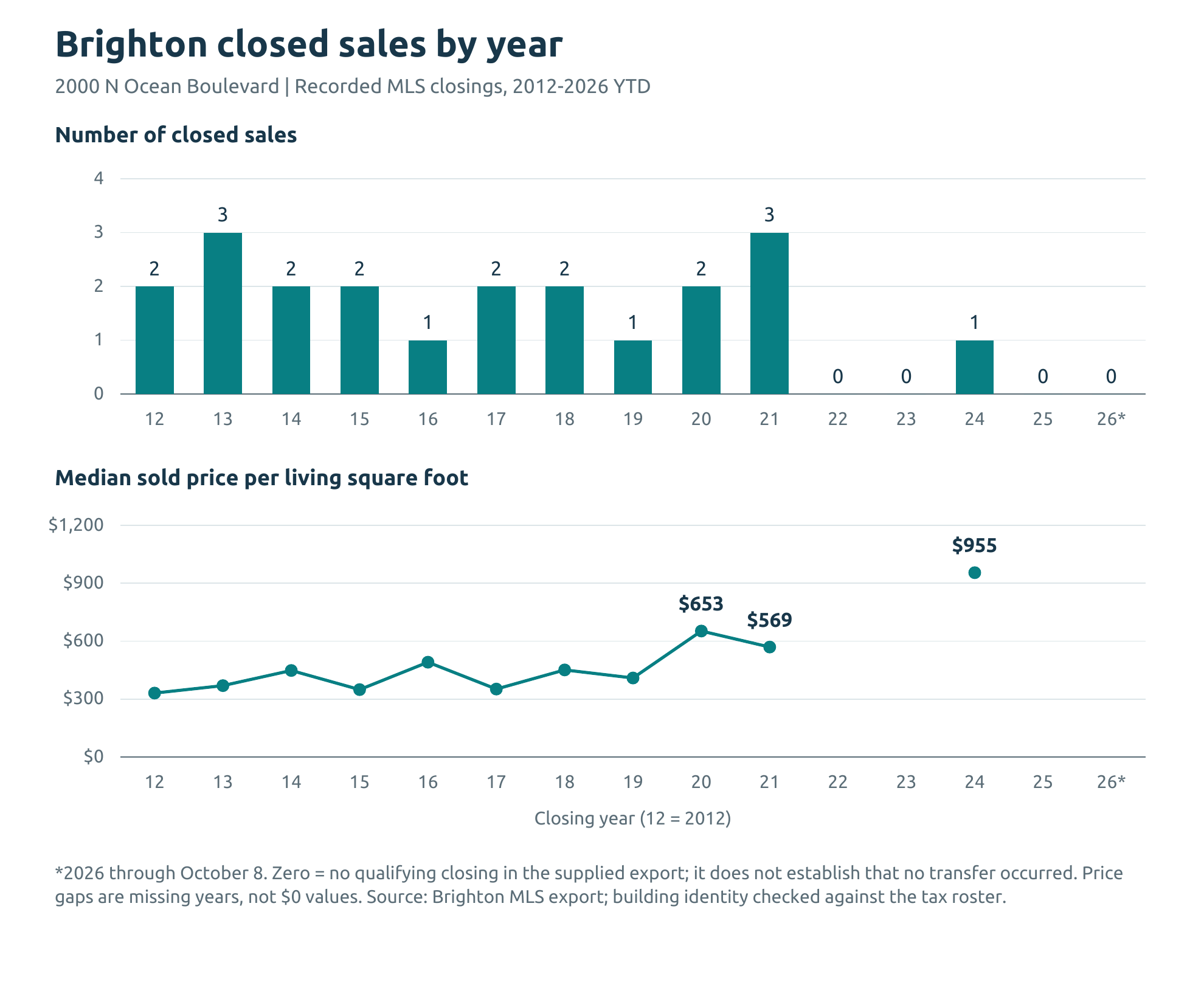
The chart makes the limited number of recent observations clear. The supplied export contains no Brighton closings for 2022, 2023, 2025 or 2026 through October 8. That describes the file we reviewed; it does not establish that no transfers occurred outside it.
Unit 303's March 2024 closing is a useful reference for a larger residence: $3.5 million for 3,666 living square feet, or $955 per square foot. Unit 104, also reported at 3,666 square feet, closed for $2.3 million in 2020.
It would be tempting to turn that difference into a Brighton appreciation rate. These were different residences, sold four years apart, and their condition, layout, views, outdoor access and improvements have not been compared. The question I started with, whether Brighton had appreciated, needed a sharper form. The analysis has to separate changes in recorded sale prices from changes in the value of a comparable residence. With six sales in six years, the first can be measured; the second cannot.
The broader comparison sample provided context. Its median sold price per living square foot rose 31.9% from 2020 to 2025 and fell 11.0% from 2024 to 2025. Those figures describe selected condominium sales in the supplied Ocean Boulevard file, excluding Brighton. The file's original search criteria were not documented, so it is a sample rather than a complete ZIP-code index, and it is not a property-specific appreciation estimate.
One further test was instructive. I compared January 1 through October 8 in both 2025 and 2026, then narrowed the same comparison sample by living area and the MLS oceanfront designation. The table shows how much the result changes with the selection rules.
| Comparison group | 2025 Jan. 1–Oct. 8 | 2026 Jan. 1–Oct. 8 | Median change |
|---|---|---|---|
| All selected comparison condos | $1,155 23 sales | $1,186 35 sales | +2.7% |
| Living area 2,400–4,000 sq. ft. | $1,017 11 sales | $891 16 sales | −12.4% |
| Same size range, with oceanfront designation | $1,028 10 sales | $1,254 11 sales | +22.0% |
Dollar figures are median closed-sale prices per living square foot; sale counts appear below each figure. All groups exclude Brighton. The oceanfront designation comes from MLS feature flags and was not physically verified. This comparison is separate from the $3 million to $5 million closed-price examples later in the article.
These changes describe the medians of the properties sold in each period. They do not measure appreciation for the same residences. Different buildings, unit sizes, floors, views and conditions can shift the result, particularly with only 10 or 11 sales in the narrowest group. Comparable selection changes the answer, which is why the brief writes its selection rules down.
Asking is not selling
The October 8, 2026 snapshot showed one Brighton residence coming to market: unit 103, 3,666 living square feet, asking $4,498,000, or $1,227 per square foot, with showings then scheduled to begin October 21. That asking price was 28.5% above unit 303's 2024 closing for the same reported size. At that date, it was competition for a Brighton seller and was listed by another brokerage. An asking price does not establish a property's value; a completed sale provides different evidence. Unit 303 is the reminder. It was listed at $3,995,000 and closed at $3,500,000, 12.4% below the asking price.
The listings that expired added another part of the history
The Brighton records contain 18 expired listing events across nine distinct residences, with historical listing dates from 2002 to 2015 and status changes through 2016.
These are listing attempts, not 18 distinct owners or properties. Several attempts can relate to the same residence, and ownership may change over time. The nine-residence count does not establish how many owners were involved.
Of the 48 concluded Brighton listing records in the reviewed history, 30 closed and 18 expired; the coming-soon listing and the closing with conflicting building identity are excluded. This is a count of marketing attempts, not a property-level failure rate. A residence can expire, return under another listing and later close. Expiration does not establish that it remained unsold or is currently available.
For an agent, an expired listing is a reason to investigate the circumstances: the asking price, condition, presentation, marketing period and competing inventory at the time. Expiration alone does not establish cause. These historical events do not establish current ownership, representation or selling motivation, and they are not a prospect list.
I also wanted cancelled listings included. The supplied Brighton records do not identify any, and the cancellation-date fields are blank, so no reliable cancellation count exists. That needs an additional MLS export.
Checking the property, not just the code
The tax file settled a detail the MLS could not. A strict condominium-code filter had excluded two older Brighton records coded "townhouse," even though the county classification and legal descriptions support condominium ownership. The reconciled history used by both this article and the revised brief now includes those records, including unit 504's 2003 closing. The address-matched file contains 31 closed records, 18 expired listing events and one coming-soon record. One closing with conflicting building identity is excluded, leaving 30 closings for analysis. It is a small correction, and it is the kind that matters. A filter applied consistently can still drop a verified Brighton sale.
What could a buyer purchase elsewhere for similar money?
For the larger Brighton residences, I used a $3 million to $5 million closed-price range. It brackets unit 303's $3.5 million sale and unit 103's $4.498 million asking price. It is a comparison range for those larger-residence examples, not a valuation range for every Brighton unit.
The supplied comparison file contains 21 other condominium closings in that range from January 2024 through October 8, 2026: one in 33431, Brighton's ZIP code, and twenty in neighboring 33432. The file gave us far more evidence from the neighboring ZIP code than from Brighton's own, and any conclusion drawn from it carries that weighting.
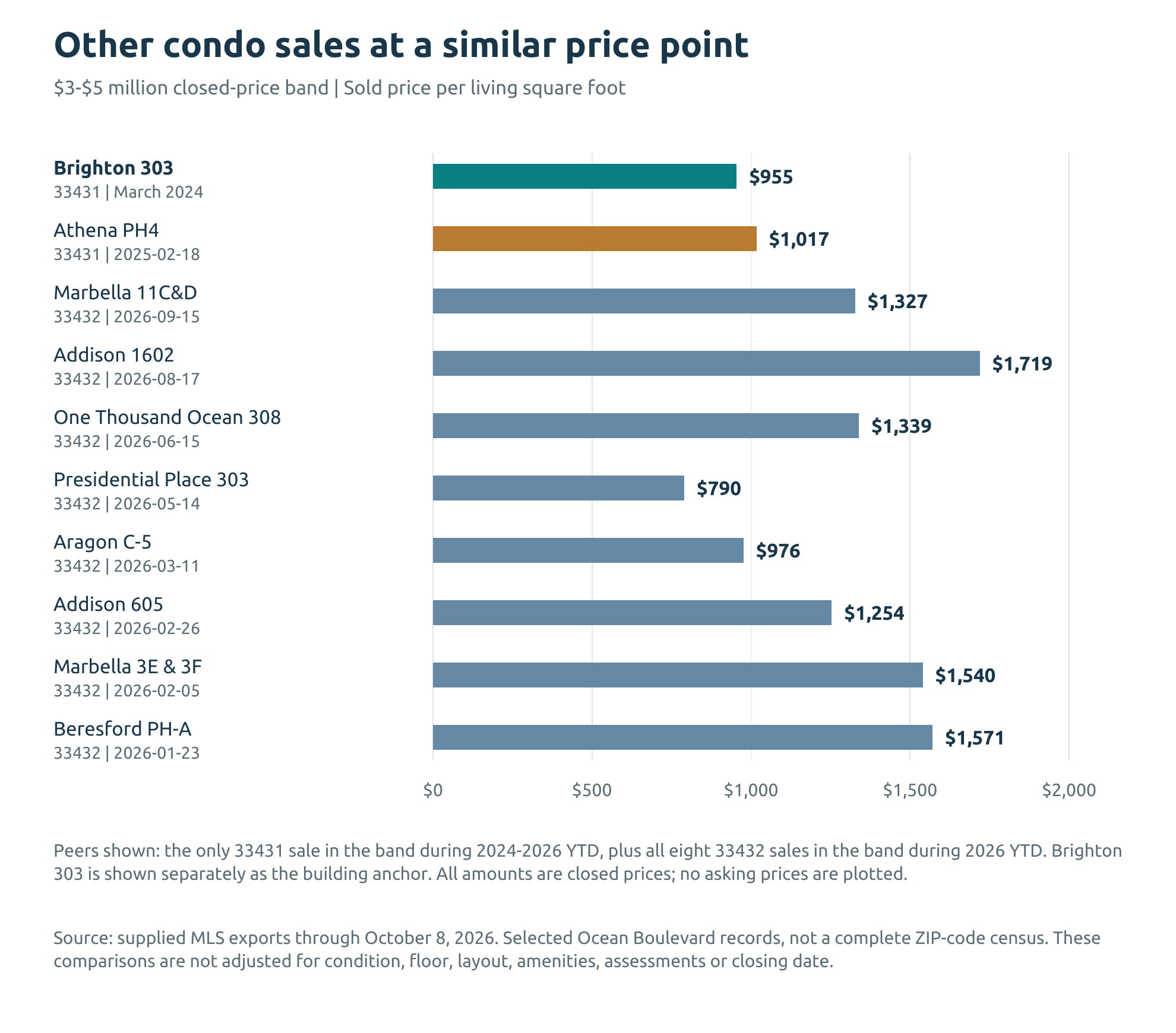
The same-ZIP sale was Athena PH4 at 2070 North Ocean Boulevard, which closed in February 2025 for about $4.02 million with 3,954 living square feet, about $1,017 per square foot. The chart below places that sale beside Brighton's unit 303 and all eight 2026 sales in the range from the 33432 portion of the file.
| Other condominium sale | ZIP | Closed price | Living sq ft |
|---|---|---|---|
| Athena PH4 | 33431 | $4,020,480 | 3,954 |
| Marbella 11C&D | 33432 | $4,050,000 | 3,052 |
| Addison 1602 | 33432 | $4,800,000 | 2,792 |
| One Thousand Ocean 308 | 33432 | $4,800,000 | 3,584 |
| Presidential Place 303 | 33432 | $3,750,000 | 4,747 |
| Aragon C-5 | 33432 | $3,675,000 | 3,764 |
| Addison 605 | 33432 | $3,500,000 | 2,792 |
| Marbella 3E & 3F | 33432 | $4,700,000 | 3,052 |
| Beresford PH-A | 33432 | $3,962,500 | 2,523 |
The differences are substantial. Within this selection, purchasers paid roughly $790 to $1,719 per living square foot. A similar purchase price can buy very different square footage, building age, services, floor level and residence configuration, and combined units and penthouses add further differences. These sales identify properties worth investigating. They do not establish Brighton's value without adjustments, and no adjustments have been made. The brief screens its own peer list a different way, by living area, an oceanfront feature flag and building age, and the two lists overlap. That is the point: comparable selection is a judgment, so the rules should be visible.
What the association's public pages did and did not tell us
Association documents are where a seller's expectations most often meet reality, so the brief reviewed what was publicly available. A December 2022 association notice scheduled roof replacement to begin in January 2023, cited engineering advice and water intrusion in some areas, and announced a special assessment. The notice does not establish that the work was completed, what it cost, whether a warranty exists, or whether a particular owner has paid. Public excerpts of the rules address leasing, pets, flooring, guests and parking; the current adopted documents were not obtained. Unit 103's October 8 listing snapshot reported a monthly association fee of about $3,768 and a 2026 tax figure of about $40,553, a unit-specific illustration from one listing rather than a building-wide number. Brighton's milestone inspection and reserve study status was not established in this review.
So the brief lists what a seller conversation needs to obtain: the adopted budget, reserve balances and the latest structural integrity reserve study, the roof project's closeout and final cost, the milestone inspection report if one exists, the assessment history, insurance documents and a completed condominium questionnaire. Finding that these were not available is not the same as finding a problem. It is the agent's list of what to ask for before quoting a price.
What the brief became
As we worked, the project grew from a community overview into a 21-page reference for an agent preparing for a listing conversation. It includes:
- Building identity, amenities, residence types and association contacts.
- Brighton's closed-sale history and the asking competition as of October 8, 2026.
- Annual sales-count and sold-price-per-living-square-foot charts, with Brighton kept separate from the comparison sample.
- An aggregate summary of historical expired listing attempts and the limits of the available status data.
- Nearby condominium comparisons with their selection rules stated.
- Reported ownership costs, association rules, capital-project history and the documents still needed.
- A seller-appointment outline and a checklist for building a unit-specific listing presentation.
The tax-file review came later and gave us the 39-parcel residential roster, which helped reconcile unit identities and classifications.
I started with a building I had not heard of. The brief gave my colleague a more informed starting point for her conversation with a Brighton owner: a building history, the competition at the time, a sense of what nearby buyers paid for similar money, and a specific list of what had to be verified before anyone recommended a price. Part of that preparation is recognizing the evidence that may challenge a seller's expectations: a sparse recent sales record, a wide spread of nearby prices, an asking price well above the last closing, and association questions still open. Bringing that to the table is the job.
The Brighton research did not produce a definitive asking price. It produced something that needed to come first: a clearer understanding of the building, the market, the competing properties and the questions that remained unanswered.
That is where a defensible pricing recommendation begins.
Data and sources
MLS analysis uses the supplied exports through October 8, 2026; 2026 figures are year to date. The comparison file contains selected Ocean Boulevard properties, not every condominium transaction in either ZIP code. Brighton's history excludes one older record with conflicting building identity and includes tax-confirmed condominium unit 504. Prices and living areas are reported values; comparisons have not been adjusted for condition, concessions, assessments or other property differences.
[1] BRIGHTON MLS.csv, supplied building and listing-history export. [2] 33431 and 33432.csv, supplied condominium comparison source; only condo-coded closed sales were used for peers. [3] 33431 Tax.csv, supplied parcel and property-classification source. [4] Brighton Condominium Association: Community Information, public rule excerpts and roof-replacement notice, reviewed October 2026.
Read or download the Brighton Agent Listing Brief (PDF, 21 pages)
About David Abernathy
David Abernathy — Luxury Real Estate Advisor : Applied AI. He serves Palm Beach County buyers and sellers with Waterfront Properties & Club Communities. He helps buyers and sellers make property decisions using local market analysis, clear sourcing, and applied AI. He was the firm’s non-competing Business Manager from 2008 through August 2026, participating in more than 1,000 listing presentations alongside the firm’s agents.
Meet David Abernathy